Listen to: The Ballad of Bill Tilley
A mining lament for childhood, labour, and loss
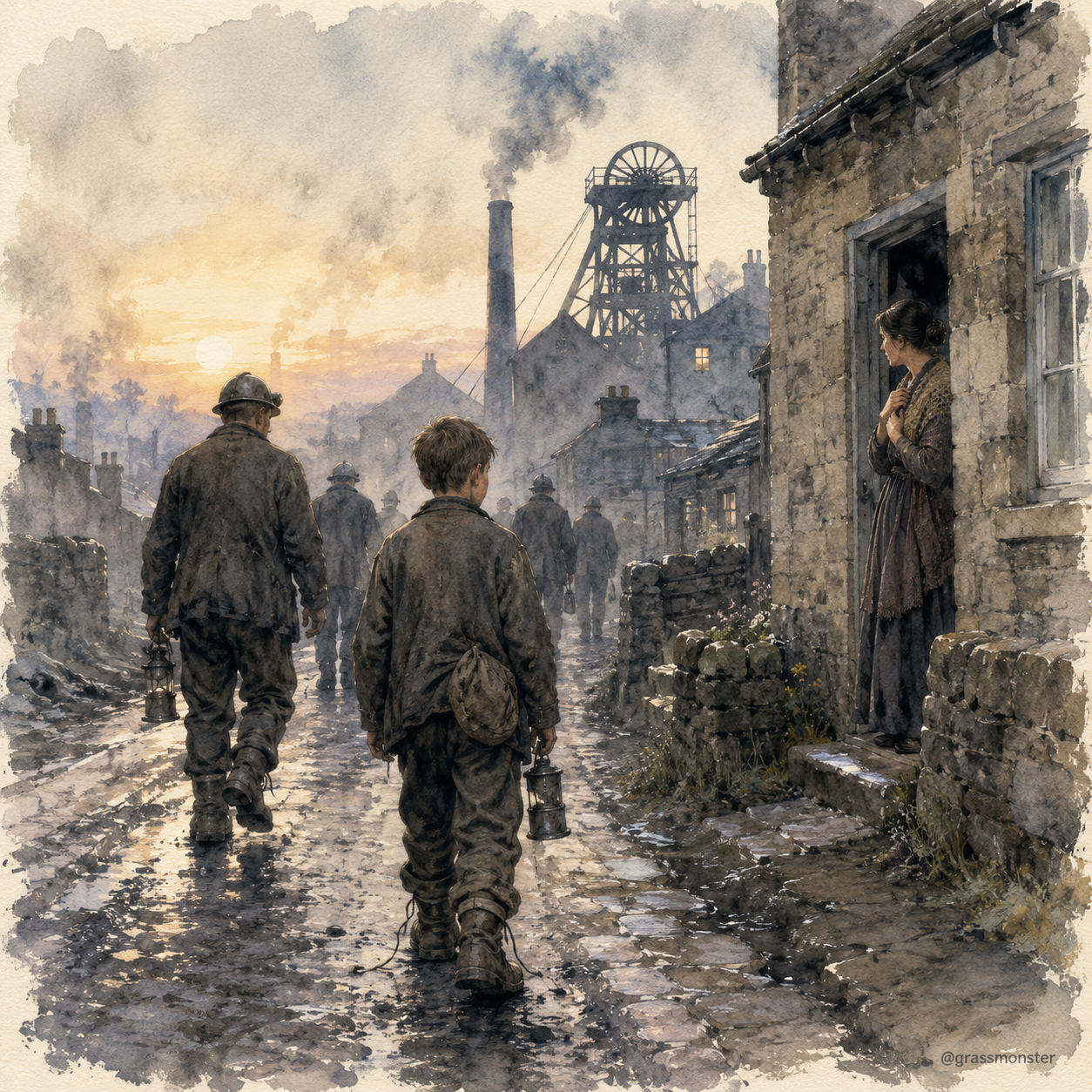 The Ballad of Bill Tilley is one of the most sorrowful songs on The Threadbare Tapes. It carries the weight of Yorkshire mining life, but it does so through the eyes of a child. That is what gives the song its deepest ache. It is not simply a song about the pit. It is a song about a boy standing at the edge of manhood before life has properly allowed him to be a child.
The story is based on a true account of a young boy's first day down a Yorkshire coal mine. The name Bill Tilley is a created name, used to carry the story with dignity and remembrance. That matters, because the song does not claim to reconstruct one official biography in detail. Instead, it gives voice to a larger truth about mining communities and the young lives that were drawn into labour too soon.
From the first moments, the song places us in a world of duty rather than choice. Morning arrives not as freshness or promise, but as obligation. The boy rises because the world around him has already decided what must be done. The tragedy is that such things once seemed ordinary.
A child at the mouth of the pit
Bill stands at the centre of the song as both one boy and many boys. He is twelve years old, still carrying the small outward signs of youth - the ill-fitting boots, the trailing laces, the eagerness to prove himself - yet already being counted among working men.
That contradiction is the emotional heart of the piece. He is proud, because children often want to be brave in the eyes of adults. He wants to belong. He wants to be worthy. But the listener hears something he cannot yet hear: that the world asking this of him is a hard world, and not a just one.
The mine entrance becomes more than a physical place. It is a threshold between childhood and labour, innocence and danger, home and the dark machinery of necessity. Once he steps towards it, the song begins to feel like a farewell even before the disaster comes.
The hardship of mining families
The Ballad of Bill Tilley understands that the pit did not only shape those who worked underground. It shaped whole streets, kitchens, mothers, fathers, and families who lived under the shadow of its demands.
The song treats that truth with great tenderness. There is the morning meal, the whispered prayer, the quiet dread, and the mother standing at the doorway trying not to let fear show too plainly. These details matter because they root the tragedy in ordinary family life. Loss is never abstract when it begins in a kitchen.
Mining communities often lived inside a hard arithmetic. Bread had to be earned. Rent had to be met. Children became workers because poverty and custom left too little room for mercy. The song does not lecture about that. It simply allows the listener to feel the cruelty of a system that could make such a thing seem inevitable.
The descent into darkness
Few images in folk song carry as much dread as the descent of the cage. In this song, it is one of the most powerful moments. The hooter sounds, the men gather, the cage drops, and the boy is swallowed by the earth.
The descent is physical, but it is also symbolic. We are moving away from daylight, warmth, and the human scale of home into the blackened underworld of labour. The mine becomes a place with its own weather, its own breath, and its own indifference.
Yet Bill smiles into the dark. That detail is heartbreaking because it preserves his innocence at the very moment it is most vulnerable. He is not reckless. He is simply young enough to believe that courage and belonging may still protect him.
The disaster and its silence
When the collapse comes, the song does not need sensational language. Timbers crack, stone shifts, lanterns swing, men shout, and then everything is changed. The horror lies partly in its suddenness. A working day becomes a death sentence in an instant.
The earth closes over him, and with that one act an entire future is erased. Not only his life, but the life he might have lived, the years he might have grown into, the family he might have become, the laughter the world above has barely come to know.
The silence after the collapse is as important as the noise before it. Folk songs often understand that grief arrives not only in cries, but in stillness. The world pauses. Words fail. The loss is too large for speech.
The sound of the song
The Ballad of Bill Tilley needs a restrained, mournful arrangement. It should feel close to the ground, close to the community, and close to the human cost of the story. This is not a song that benefits from excess. Its power lies in simplicity, sorrow, and the steady tread of remembrance.
The music should carry the atmosphere of a Yorkshire mining lament - dark but human, heavy but not theatrical. A measured pace, spare instrumentation, and a vocal atmosphere of witness rather than display all serve the song well.
In the Jenny Toledo folk project, the recording gives the piece a consistent vocal and visual atmosphere, but the centre remains the human-authored song itself: its grief, its historical feeling, and its compassion for the children and families caught beneath industrial necessity.
Why this song matters
The Ballad of Bill Tilley matters because it remembers those lives that history can too easily compress into statistics, eras, or industries. Mining history is often told through output, strikes, ownership, and closure. Songs can do something different. Songs can return us to the kitchen door, the child, the mother, the breath before descent.
It also matters because it honours working-class grief with seriousness. There is no romantic varnish here. The song recognises bravery, but it does not confuse bravery with justice. A child may be brave, and still be wronged by the conditions that demanded such bravery from him.
The created name Bill Tilley allows the song to act as a vessel of remembrance. He stands for one boy and for many. In that way, the song becomes not only a lament, but a memorial.
Connection to The Threadbare Tapes
As the seventh track, The Ballad of Bill Tilley deepens the album's concern with ordinary lives under pressure. The Threadbare Tapes has already travelled through exile, debt, pursuit, remembrance, hidden voice, and invention. Here it enters the pit village and the mining street, where labour and sorrow live close together.
This song belongs naturally within the album because it carries the same essential values: attention to overlooked lives, respect for hardship, and the belief that memory matters. The Threadbare Tapes is not interested in grand public history alone. It is interested in the felt human truth beneath it.
The Ballad of Bill Tilley is therefore more than a mining song. It is a lament for childhood interrupted, for families forced into endurance, and for the old communities where courage was often demanded before life had properly begun.
It leaves behind not only sorrow, but witness. And witness is one of the noblest duties a song can serve.