Listen to: Rocket
A song of invention, labour, and human reach
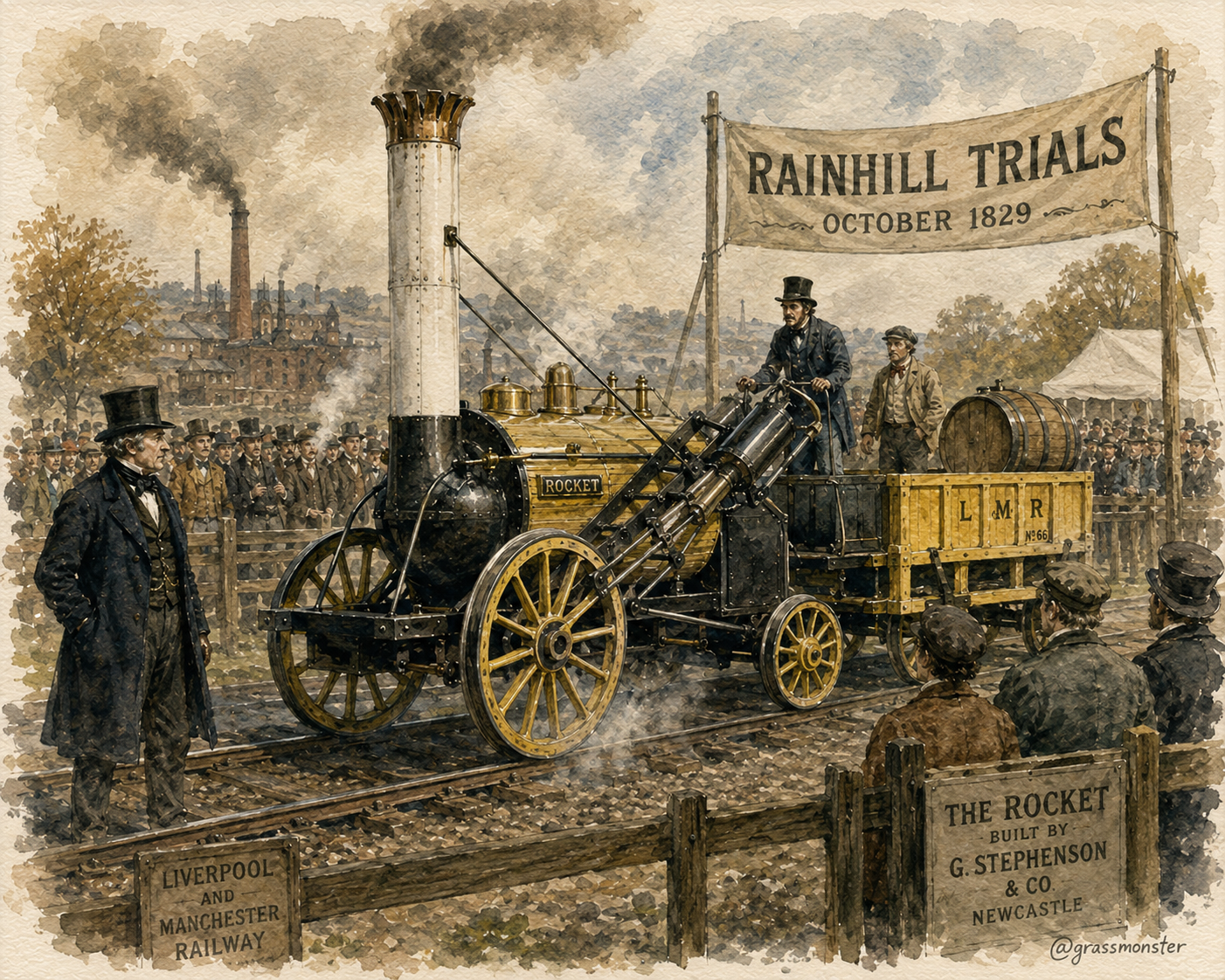 Rocket is a song about invention, but not invention in the abstract. It is concerned with the practical miracle that happens when imagination, labour, hardship, and technical skill meet at exactly the right moment in history. It takes the story of George Stephenson's Rocket and turns it into something more than a mechanical triumph. It becomes a song about ordinary life changing pace.
The title carries a kind of brightness. It suggests speed, possibility, and forward movement. Yet the world that gave birth to Rocket was not polished or easy. It was a world of soot, iron, noise, hunger, grit, and long effort. That contrast gives the song its strength. Out of a blackened industrial landscape came a machine that helped redraw time itself.
Rocket therefore stands not only as a tribute to engineering, but as a reflection on what human beings can build when necessity and vision are forced into partnership. It is a northern song, a labour song, and an invention song all at once.
The machine and the men behind it
One of the most important things about Rocket is that it does not treat the locomotive as if it arrived from nowhere. Machines do not fall from the sky complete. They are made by minds, hands, tools, setbacks, calculations, experiments, and the stubborn refusal to stop when others doubt the attempt.
George Stephenson stands at the centre of that effort, but he does not stand there alone. Around him are workers, engineers, assistants, foundries, furnaces, and all the unnamed labour that turns an idea into iron reality. The song honours that wider field of work.
That matters because progress is often remembered too neatly. History likes a single name. Songs can do something better. Songs can restore atmosphere, effort, and human texture. In Rocket, invention is not some sterile act of genius. It is sweaty, risky, practical, and full of belief.
Rainhill and the theatre of progress
The Rainhill Trials give the song its dramatic heart. Here invention becomes public. The machine is no longer hidden in workshop and yard. It must prove itself in front of doubters, investors, competitors, labourers, and curious onlookers.
There is something almost theatrical in that moment. Rocket stands waiting, not as decoration, but as argument. Her brass and iron are not meant to impress by beauty alone. They are meant to demonstrate that a new age can move faster than the old one.
When she succeeds, the victory is larger than one trial. It is a shift in imagination. People begin to see that distance, labour, trade, travel, and opportunity may soon operate under different rules. That is why the song carries excitement without losing seriousness. The machine is real, but so is the change in human expectation that comes with it.
The changing pace of ordinary life
Rocket is not only about industrial history. It is about the way technology enters the lives of ordinary people. Before the railway, distance kept communities apart in harder ways. Journeys were slower. Trade was narrower. News travelled differently. Ambition itself had more mud to walk through.
The song understands that. It recognises that the machine's importance lies not merely in metal or motion, but in consequence. The village moves closer to the city. Goods move more quickly. Possibility expands. A person who once felt trapped inside the narrow limits of place can begin to imagine a wider horizon.
That does not make the song naive. Progress always carries complication with it. But Rocket is interested in that first leap of feeling - the moment when invention seems to pull the world forward, and when even ordinary people sense that life may begin to move at a different speed.
The sound of the song
Rocket needs movement in its arrangement. It should feel purposeful, not frantic. There should be a sense of building energy - a gathering of force, rhythm, and momentum, like something mechanical and human working together.
The song can carry a folk character while still evoking industry. Acoustic instruments, rhythmic drive, and a sense of measured propulsion all suit the subject well. The music should not become cold or over-technical. Its task is not to imitate machinery literally, but to convey the emotional force of invention.
In the Jenny Toledo folk project, the recording gives Rocket a consistent vocal and visual atmosphere, but the centre remains the human-authored song itself: its admiration for labour, its sense of place, and its belief that invention is part of the human story, not apart from it.
Why this song matters
Rocket matters because it restores poetry to a piece of history that is often reduced to dates and diagrams. It reminds us that engineering can be emotional, that invention can carry social meaning, and that industrial progress was lived by human beings, not by textbooks.
The song also matters because it honours the northern tradition of making, building, testing, and enduring. This is not a song of luxury. It is a song of effort. It understands that some of the greatest changes in history come not from ornament, but from applied thought and hard work.
There is also something hopeful in Rocket. It looks at a machine and sees not only mechanism, but aspiration. It sees the human desire to overcome slowness, distance, and limitation. In that sense, the song becomes a meditation on reach - how far the mind can travel before the body catches up.
Connection to The Threadbare Tapes
As the sixth track, Rocket broadens the world of The Threadbare Tapes again. After songs of exile, debt, pursuit, remembrance, and hidden musical awakening, this song opens out into invention, industry, and the public energy of social change.
Yet it still belongs naturally within the album. The Threadbare Tapes is interested in lives shaped by pressure, labour, memory, and longing. Rocket adds another thread to that fabric by showing how human effort can leave a mark not only on one life, but on the movement of a nation.
It is also a song that balances the personal and the historical very well. The locomotive is part of national memory, but the song keeps returning us to people: workers, travellers, onlookers, and the ordinary lives altered by new speed and connection.
Rocket is therefore more than a tribute to a famous engine. It is a song of iron hope, practical genius, and the stubborn human wish to push the world beyond the limits it once accepted.
Keywords: Jenny Toledo, Jenny Toledo folk project, Rocket, The Threadbare Tapes, folk music reflection, George Stephenson, Rainhill Trials, steam locomotive song, industrial revolution ballad, northern grit, invention in song, railway history, acoustic folk storytelling, human songwriting, labour and progress, Mairtin Olubaigh, SYME Music Publishing, Hengest Records