Listen to: White Feather
A song of defiance without violence
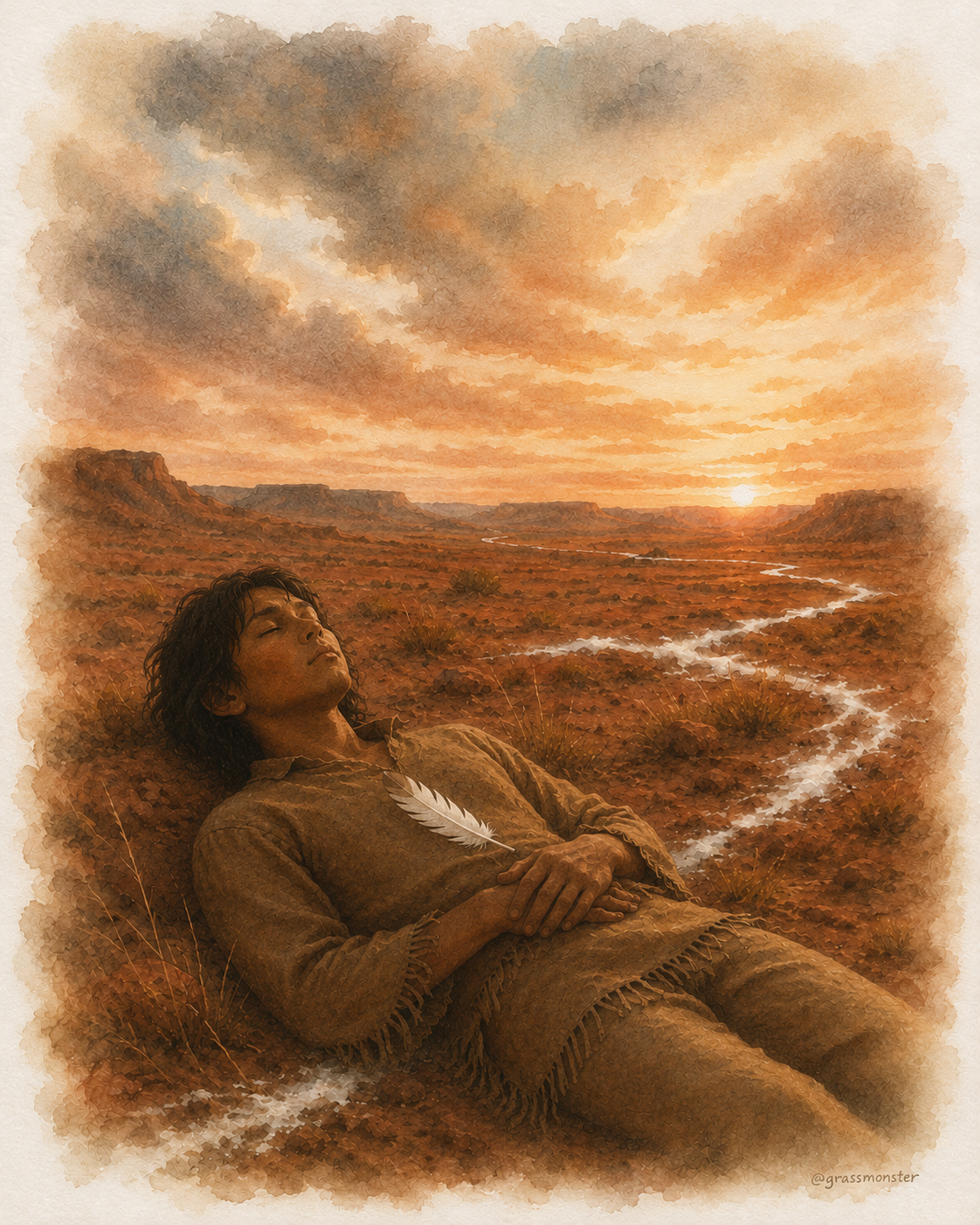 White Feather is a song of quiet resistance. It does not move through battle cries, raised weapons, or the theatre of conquest. Its power comes from stillness. A youth stands against the taking of land not by force, but by presence, memory, and moral courage.
At the centre of the song is White Crow, a young man of Indigenous ancestry, shaped by wind, stone, silence, and the long teaching of the earth. He is not presented as a warrior in the usual sense. He does not win by overpowering others. He endures. He witnesses. He refuses to let the land be reduced to paper, lines, and ownership claims.
The song's great beauty lies in that restraint. White Feather understands that defiance can be gentle and still be unbreakable. A feather may seem fragile to the eye, yet in the song it becomes heavier than any deed, map, or command.
The naming of White Crow
Within the story-world of the song, White Crow's name carries the weight of an omen. It is said that near the hour of his birth, a crow settled on the ridge above the red basin and left behind a single white feather. The sign was strange enough to be remembered, and gentle enough to be trusted.
A crow is a watcher, a keeper of memory, a creature of intelligence and survival. A white feather speaks differently: of peace, conscience, innocence, and covenant. Together, the two images form a name of contradiction and calling.
White Crow is the one marked to see what others overlook. He is the quiet watcher, the child of the ridge, the youth whose life is bound to the land without claiming to own it. His name does not make him larger than others by force. It makes him responsible.
The name is not used as decoration. It belongs to the moral centre of the song. White Crow carries the feather because the feather has always carried him.
The untamed land of White Feather
The landscape of White Feather feels wide, red, and ancient. It is a place of basins, ridges, wind, dust, stone, and silence. It is not empty land, though strangers may mistake it for such. It is full of memory.
The song asks the listener to understand land not as property alone, but as presence. A tree becomes a council and a chronicle. A river becomes scripture in motion. A horizon becomes something no hand can fold into ownership.
That is the first moral challenge of the song. It asks whether a place can truly be known by measuring it, dividing it, and naming it on a map. White Crow knows another kind of knowledge: the knowledge carried in walking, listening, watching, remembering, and belonging without possession.
White Crow and the lessons of the earth
White Crow is taught not by marketplace bargain or official instruction, but by the land itself. This gives the song a deep spiritual atmosphere without needing to pin it to one narrow explanation. His wisdom is elemental. It comes through bark, bone, dust, breath, weather, and time.
He understands that the living world is not merely a resource waiting to be claimed. It has voice, pattern, and memory. The stone has endured. The river has carried. The tree has counted seasons in rings no court has read.
This is why White Crow's solitude does not feel like loneliness. He is accompanied by the world around him. Silence itself becomes his companion, and in that silence there is a strength more enduring than steel.
The march of maps and claims
Against this quiet knowledge comes progress, dressed in certainty. The strangers arrive with papers, claims, boundaries, and a language of command. They bring the idea that land must be divided before it can be valued.
The song treats that arrival with unease. The papers rattle louder than birdcall. Lines are drawn where none had been. The living earth is translated into property, and property into power.
That is where White Feather becomes more than a landscape song. It becomes a moral song. It asks what is lost when ownership becomes louder than memory, and when maps are allowed to speak over the ground itself.
The vigil of the feather
The central image of the song is unforgettable: White Crow lying beneath the dusk firelight with a single white feather resting on his chest. It is a small gesture, yet it carries the weight of a vow.
The feather becomes a sign of covenant between heart and soil. It says that he belongs to the land without claiming to own it. It says that his defence of the earth will not be made in the image of those who threaten it.
This is the quiet genius of the song. The feather does not threaten. It judges. Those who see it feel uneasy because they are forced to stand before a truth older than their papers. The tribunal is not a court of men. It is the land remembering itself.
Strength in restraint
White Feather is careful not to confuse peace with weakness. White Crow holds no rifle and brandishes no threat, but his empty hands are not empty of meaning. They declare that there are forms of strength conquest cannot understand.
His resistance is not passive. It is disciplined. Night after night, he keeps watch. The chalk line marked by others becomes not a prison, but a threshold. He turns the place of division into a place of witness.
The song suggests that some of the loudest powers in history have feared the quiet most of all. Noise can be answered with louder noise. But patient moral presence is harder to defeat. It asks too much of the conscience.
The sound of the song
White Feather needs a spacious arrangement. It should feel as if the listener is standing under a wide sky, with wind moving across stone and dust. The music should not crowd the song. It should allow silence to remain part of the composition.
The vocal atmosphere should carry restraint, reverence, and inward strength. This is not a song of triumph in the obvious sense. It is a song of endurance. The melody should drift like prayer and stand like a ridge.
In the Jenny Toledo folk project, the recording gives White Feather a consistent vocal and visual atmosphere, but the centre remains the human-authored song itself: its moral courage, its reverence for land, and its refusal to mistake gentleness for surrender.
Why this song matters
White Feather matters because it speaks to the old conflict between possession and belonging. It asks whether land can be truly held by documents alone, and whether memory can be erased simply because power has learned to write neatly.
The song also matters because it gives dignity to non-violent defiance. White Crow does not defeat his opponents through force. He outlasts them through witness. His courage is not the courage of attack, but the courage of remaining.
There is great tenderness in that. The feather is fragile, but its meaning is not. It becomes the song's central truth: that the quiet may outlast the loud, and that the earth remembers those who stood for her without raising a weapon.
Connection to The Threadbare Tapes
Within The Threadbare Tapes, White Feather stands as a song of witness, restraint, and moral courage. The album is full of lives under pressure: the exiled, the indebted, the hunted, the grieving, the visionary, the labouring, and the haunted. White Crow belongs among them because he too stands before a force larger than himself.
Yet his story brings a different kind of pressure into the album. This is not only social judgement or private grief. It is the pressure of history itself: the attempt to divide, own, rename, and forget what was never truly empty.
The Threadbare Tapes is concerned with memory, and White Feather is one of its clearest memory songs. It tells us that the land is not silent, that defiance may be gentle, and that the smallest sign can carry the largest truth.
White Feather is therefore a lament and a promise. It mourns what men try to take, but it also insists that the earth remembers still.
Keywords: Jenny Toledo, Jenny Toledo folk project, White Feather, The Threadbare Tapes, White Crow, folk music reflection, song of defiance, land and memory, Indigenous ancestry, non-violent resistance, moral courage, white feather symbolism, acoustic folk ballad, earth remembrance, spiritual folk storytelling, human songwriting, Mairtin Olubaigh, SYME Music Publishing, Hengest Records