Listen to: The Prescient
A song about sight before the world can see
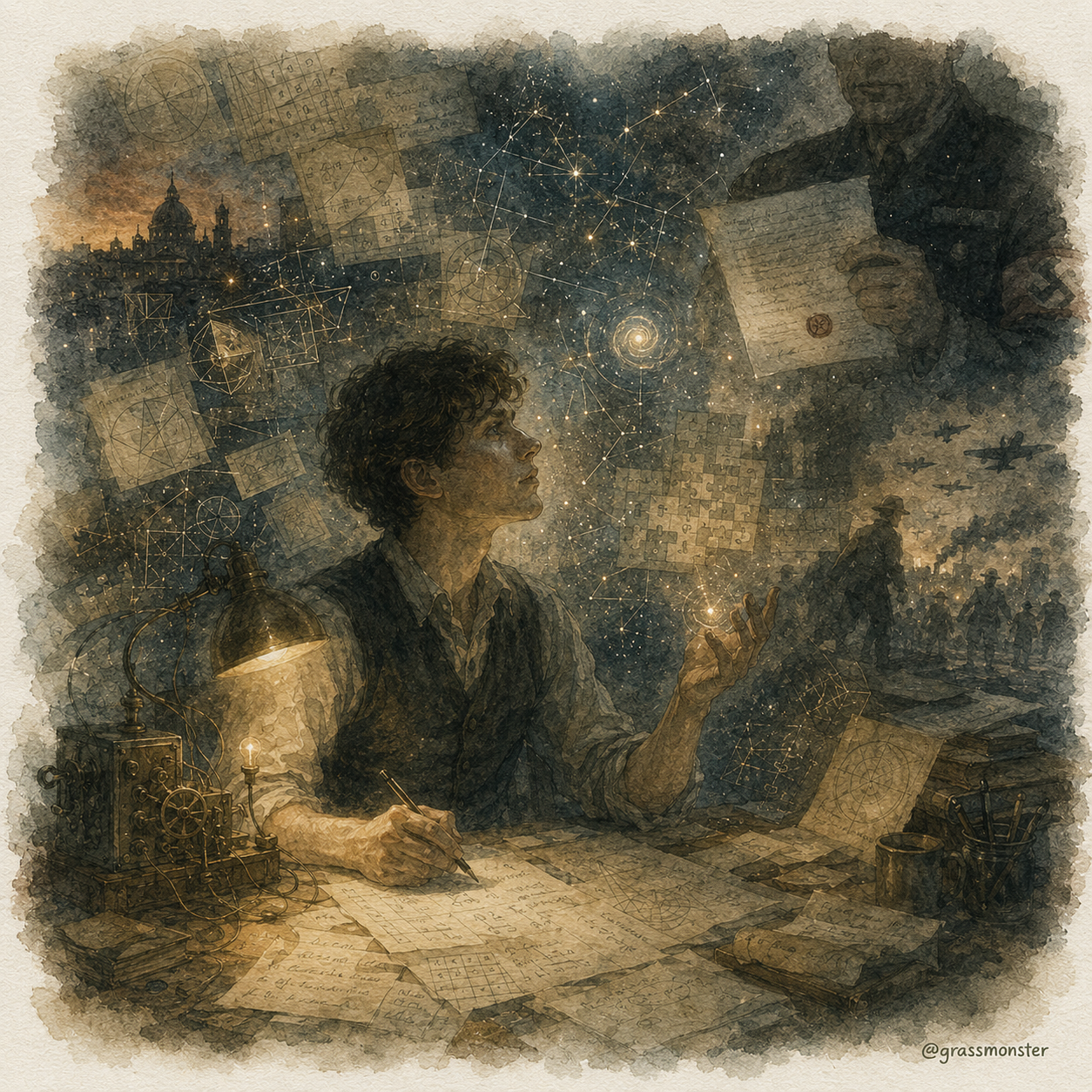 The Prescient is a song about the strange burden of seeing ahead. It stands in that lonely place where intelligence, instinct, imagination, and warning all meet. Some people glimpse the shape of tomorrow before the world has learned the language to describe it. That gift can look like genius from a distance, but it can also feel like exile to the person carrying it.
The title itself suggests more than cleverness. To be prescient is not merely to know something. It is to sense what is coming before others are ready to admit it. The song carries that uneasy atmosphere: a mind working in advance of its age, surrounded by people who may benefit from its vision while failing to understand its cost.
There is something deeply human in that. The world often celebrates insight only after it has become useful, safe, or famous. But the person who sees early may live through doubt, suspicion, silence, and loneliness before recognition arrives.
The mind as a room of codes
The Prescient feels as though it belongs inside a room of paper, symbols, machines, wires, memory, and unanswered questions. It is a song of thought in motion. Not loud thought, but concentrated thought: the kind that sits through the small hours while others sleep.
Its atmosphere carries echoes of codebreaking, mathematical imagination, early computing, and the private pressure of a mind trying to solve what others cannot yet name. The figure at the centre of the song feels like someone who has learned to listen to patterns hidden beneath ordinary noise.
That is what gives the song its quiet tension. The world outside may look normal, but inside the mind everything is moving. Numbers turn. Signals flicker. Meanings appear and vanish. A future is being assembled from fragments.
The loneliness of being early
There is a particular loneliness in being ahead of time. It is not the loneliness of having nothing to say. It is the loneliness of having something to say before anyone knows how to hear it.
The Prescient understands that kind of isolation. It does not present foresight as an easy blessing. A person who sees further may also suffer more sharply, because they can sense consequences before others feel them. They may recognise danger before it has a public name. They may imagine possibilities before society has made room for them.
This gives the song its emotional centre. It is not simply about brilliance. It is about the human cost of brilliance when the world is slow, frightened, or careless with those who think differently.
Humanity and machinery
The song also sits at the border between human feeling and machine logic. That border is one of the most important themes in the modern world, but The Prescient treats it through atmosphere rather than argument.
Machines may calculate, sort, remember, and predict, but they do not carry sorrow in the human sense. A machine can process a pattern, but it cannot know what it means to be misunderstood, loved, judged, or left alone with a dangerous thought.
The Prescient therefore becomes a song about the human mind behind the machine. The machine may become famous, but the person remains vulnerable. The wires and symbols are not cold in this song. They are lit by sleeplessness, pressure, imagination, and moral urgency.
Echoes of Alan Turing
The song carries a discreet echo of Alan Turing: not as a flat history lesson, but as a presence behind the glass. He stands in cultural memory as one of those figures whose mind helped alter the modern world, while his life also reminds us how cruelly society can treat those it does not understand.
The Prescient does not need to turn that echo into a simple biography. Its power lies in suggestion. A room, a machine, a code, an apple, a question of identity, a mind under pressure - these details can carry more force when handled with restraint.
In that sense, the song is not only about one man or one story. It is about the wider tragedy of human vision being recognised too late, and human dignity being denied by those who should have protected it.
The sound of the song
The Prescient needs a careful arrangement. It should feel thoughtful, interior, and slightly mysterious, as if the listener has entered a room where something important is being worked out in silence.
The music should not rush. It should allow space for unease, calculation, and reflection. Subtle rhythmic movement can suggest machinery or thought patterns, but the emotional weight must remain human. This is not a song about technology replacing feeling. It is a song about feeling trapped inside a world that does not yet understand the technology, the person, or the warning.
In the Jenny Toledo folk project, the recording gives The Prescient a consistent vocal and visual atmosphere, but the centre remains the human-authored song itself: its compassion, its intelligence, its coded sorrow, and its respect for the mind that sees beyond the present moment.
Why this song matters
The Prescient matters because it speaks to anyone who has ever felt out of time with the world around them. It is a song for the misunderstood thinker, the quiet inventor, the hidden worker, the person whose insight becomes valuable only after they have paid heavily for it.
It also matters because it asks us to think carefully about progress. Progress is not only the creation of new tools. It is also the moral question of how we treat the people who make, imagine, warn, and discover. A society can be technically advanced and still be morally backward.
That is the wound at the centre of the song. It honours brilliance, but it also mourns the failure to honour the person who carried it.
Connection to The Threadbare Tapes
As the eighth track, The Prescient brings a different kind of sorrow into The Threadbare Tapes. After songs of exile, debt, pursuit, remembrance, musical awakening, invention, and mining hardship, this track turns inward towards mind, foresight, code, and moral failure.
Yet it belongs naturally within the album. The Threadbare Tapes is full of lives under pressure. Here the pressure is intellectual, social, and deeply personal. The central figure is not chased across a field or lowered into a mine, but is still trapped by forces larger than himself: ignorance, fear, secrecy, and judgement.
The album's wider world is concerned with dignity. The Prescient continues that work by asking us to remember the dignity of the mind that sees too early, the person who thinks too deeply, and the human being hidden behind the achievement.
The Prescient is therefore a song of code and conscience. It looks towards the future, but its deepest question is timeless: what good is progress if compassion arrives too late?
Keywords: Jenny Toledo, Jenny Toledo folk project, The Prescient, The Threadbare Tapes, folk music reflection, Alan Turing inspired song, codebreaking in song, early computing, prescience, misunderstood genius, human dignity, technology and humanity, moral folk song, acoustic folk storytelling, human songwriting, Mairtin Olubaigh, SYME Music Publishing, Hengest Records