Listen to: Miss Kelly Sears
A song of smoke, secrets, and musical awakening
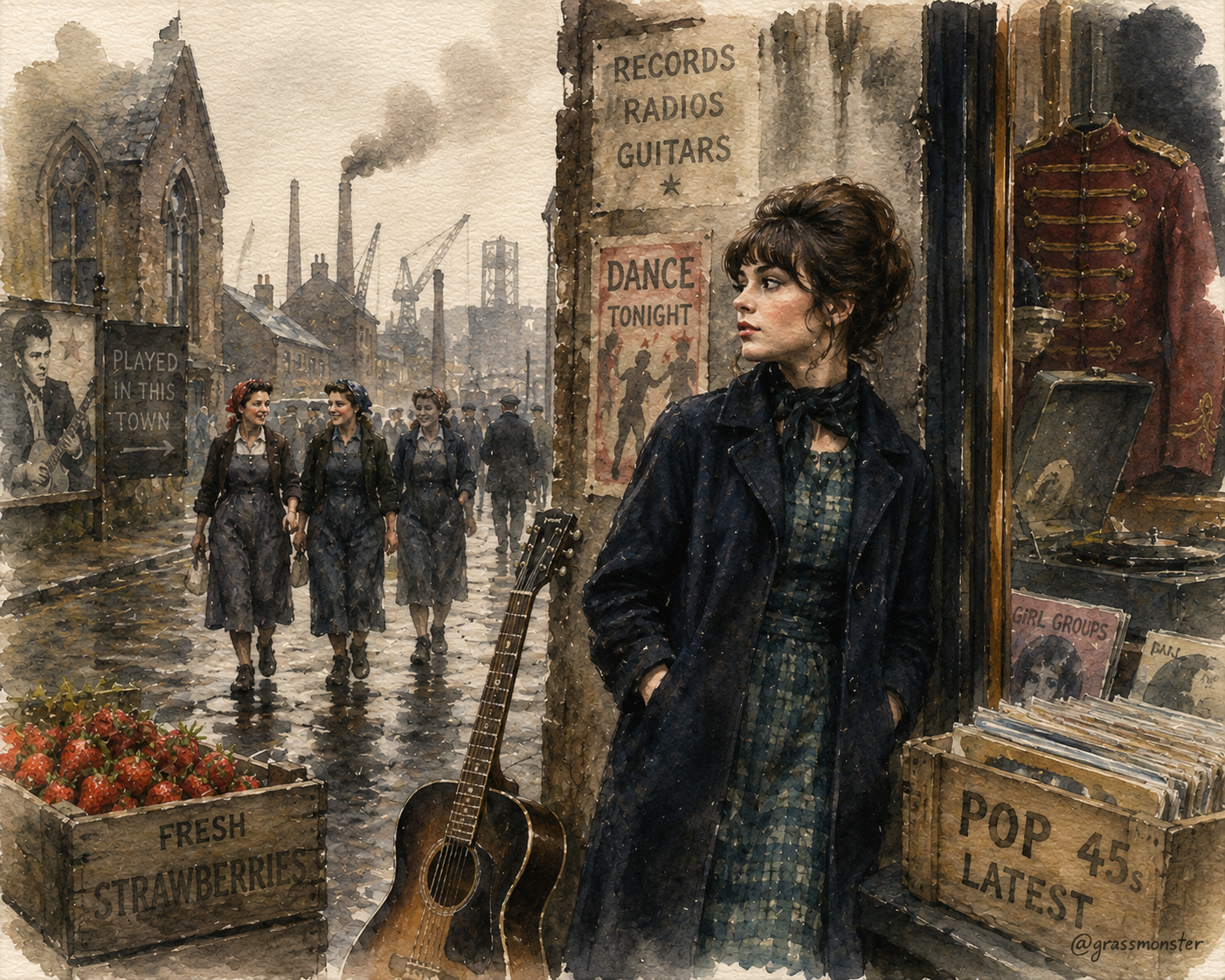 Miss Kelly Sears is a song built around mystery. It walks through the grey streets of a northern world where music is not yet a public triumph, but a private signal moving through walls, alleys, chapels, kitchens, docks, stairwells, and half-lit rooms.
At its centre is Kelly Sears, a girl whose name feels ordinary at first, yet begins to sound stranger the longer it is held in the mind. She belongs to a world of backstreets, aunt-led households, borrowed records, cheap guitars, wireless sets, and post-war rooms where silence was often treated as a virtue.
The song does not explain her too quickly. That is part of its strength. Kelly Sears is not presented as a solved biography. She is a figure of suggestion: a voice, a riddle, a half-open door, and a trace of something larger stirring behind the soot-darkened glass.
The girl in the grey years
The setting of Miss Kelly Sears matters deeply. The song feels rooted in those grey years after war, when ordinary houses carried more silence than comfort, and ambition often had to whisper before it dared to sing.
Kelly appears in this world as someone touched by melody before the world around her quite knows what to do with it. Her life is not dressed in glamour. It is domestic, constrained, and watched over by habit. Yet beyond the curtains, another education is waiting: dock roads after rain, factory girls at the gate, boys whistling in alleys, and the crackle of songs from rooms nearby.
She is shaped by the life around her. Not by privilege, not by polish, but by atmosphere. The music enters through gaps. A tune through a wall. A rhythm from the street. A chord half-learned. A name half-hidden. A future not yet lit, but quietly gathering colour.
A name that behaves like a clue
Miss Kelly Sears is one of those song titles that does more than identify a character. It asks to be listened to. The name feels plain enough, but there is a private mischief in it, as if the syllables have been arranged to carry a second meaning without confessing it openly.
That is where the song becomes playful in a quiet, cryptic way. It hints at masks, stage names, old riddles, and popular memory without turning those hints into blunt explanation. The mystery works because it remains discreet.
Some names in songs are not merely names. They are doors left slightly open. Kelly Sears belongs to that tradition. The listener may pass by without noticing. Or the listener may stop, turn back, and wonder whether the song has placed something in plain sight after all.
Singing in the forgotten chapels
The chapel imagery gives the song a haunted tenderness. Kelly does not arrive in a bright theatre. She sings where sound has been left behind: in forgotten chapels, rooms of dust, broken harmoniums, old echoes, and stone that remembers voices better than people do.
There is something powerful in that. The song suggests that music often begins before anyone calls it art. It begins as a private rebellion against silence. It begins when a person tries a note in a room that nobody important is watching.
Kelly's voice in those spaces feels like both hymn and disturbance. It belongs to the old world, but it also presses against it. It carries the feeling of a generation about to move from restraint into colour, from quiet rooms into louder streets, from inherited sadness into new rhythm.
The following of the factory girls
The factory girls give the song its chorus of ordinary witnesses. They are not distant admirers. They are part of the same world: working hands, soot beneath nails, lives measured by shifts, wages, family duty, and small freedoms stolen where possible.
When they follow Kelly's songs, it is not celebrity they are following. It is recognition. They hear something of themselves in the melody: the longing to be more than useful, more than quiet, more than the role already assigned.
That is why the song feels communal as well as mysterious. Kelly's voice becomes a lantern carried from cellar to stairwell, from kitchen to tram stop, from chapel to factory gate. What begins as one voice becomes a shared signal.
The sound of the song
Miss Kelly Sears needs an arrangement that moves between folk memory and early pop electricity. It should not abandon the old world too soon, because the whole point is the crossing from one age into another.
The sound should carry backstreet weather, chapel echo, cheap guitar strings, and the first glimmer of the brighter decade ahead. There should be a sense of rhythm beginning to loosen its collar. The song is not yet in full Swinging Sixties sunlight, but it can see the colour coming.
In the Jenny Toledo folk project, the recording gives Miss Kelly Sears a consistent vocal and visual atmosphere, but the centre remains the human-authored song itself: its riddle, its restraint, its northern setting, and its fascination with how music can form inside ordinary lives before history notices.
Why this song matters
Miss Kelly Sears matters because it understands that musical change does not begin only on famous stages. It begins in rooms, streets, families, rumours, names, instruments, and half-heard songs. It begins when someone listens differently.
The song is about a girl, but it is also about a cultural moment: the narrow passage between post-war grey and the coming explosion of colour. It catches the feeling of a world preparing to sing more loudly than it had been allowed to before.
It also matters because it keeps its mystery intact. Not every song should explain itself until nothing remains. Some songs are meant to leave a listener with a question. Miss Kelly Sears does exactly that. It is not a solved puzzle. It is the puzzle left singing.
Connection to The Threadbare Tapes
As the fifth track, Miss Kelly Sears brings a different kind of thread into The Threadbare Tapes. After songs of exile, debt, pursuit, and remembrance, this track turns towards voice, secrecy, youth, and musical awakening.
It keeps the album close to overlooked lives, but it also introduces a brighter current beneath the surface. There is still hardship here, still smoke, still silence, still constrained rooms. But there is also rhythm, wit, mischief, and the first sense that music may become a ladder out of the grey.
The Threadbare Tapes is a world of worn lives and hidden meanings. Miss Kelly Sears belongs perfectly within it because she is both ordinary and strange, local and elusive, simple and coded. She is a voice shaped by the street, the chapel, the factory gate, and the secret alphabet of popular song.
Miss Kelly Sears is therefore not just a character. She is a signal. A name. A rumour. A tune behind a wall. A girl standing at the edge of colour before the decade turns bright.
Keywords: Jenny Toledo, Jenny Toledo folk project, Miss Kelly Sears, The Threadbare Tapes, folk music reflection, northern folk ballad, Liverpool backstreets, post-war northern life, early pop formation, musical awakening, hidden name song story, folk cipher story, forgotten chapel songs, factory girls, Swinging Sixties influence, human songwriting, Mairtin Olubaigh, SYME Music Publishing, Hengest Records