Listen to: Where the Kop Still Weeps
A remembrance song beneath the roar
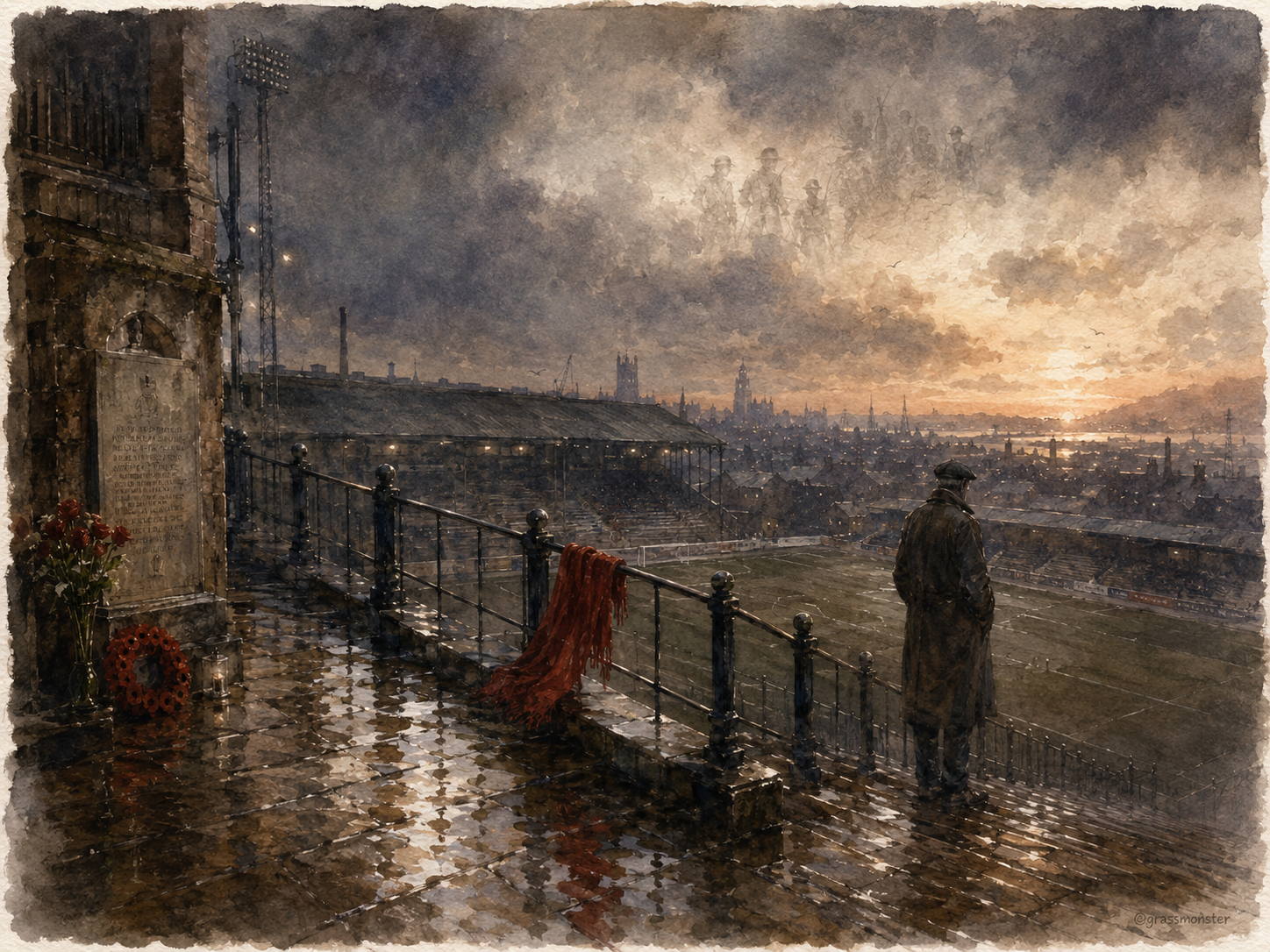 Where the Kop Still Weeps is a song about memory hidden inside public noise. It listens beneath the thunder of a football crowd and hears something older: the sorrow of young men taken from home, sent into war, and remembered through a name that still echoes from a terrace.
The song does not treat football as trivial, nor war as decoration. It understands that public places can carry private grief. A stand may be built from steel, concrete, steps, and song, but a name can carry a wound. The Kop is not only a place of anthem and colour. It is also a word tied to a far hill, a battlefield, and the terrible machinery of Empire.
That is the emotional force of the song. It asks the listener to hear both sounds at once: the roar of the living and the silence of the dead.
The echo of Empire and the football ground
It is a sombre truth, too often repeated in the ledger of Empire, that the glories of the football ground and the horrors of the battlefield were not always kept apart. Men who stood on terraces, worked in docks, walked city streets, and knew the ordinary hopes of youth were also drawn into wars fought far from home.
In the days when Liverpool was still shaping its sporting identity, another call reached young men across Britain and Ireland. It was not the call of the crowd, but the call of military duty, wrapped in the old language of honour, crown, and Empire.
Where the Kop Still Weeps stands in that uneasy place where civic pride, football memory, and imperial grief meet. It does not shout accusation. It mourns. It remembers. It asks what gets carried forward when history turns a place-name into a chant.
The call to South Africa
The year was 1899, when the call to South Africa rang through streets, workshops, docks, and homes like a grim trumpet. Young men were told that honour lay in service, that duty stood above fear, and that war would make boys into men.
But songs are allowed to ask what official language often refuses to ask. What of the mothers who clutched at sleeves? What of fathers who turned their eyes away because grief had no permission to speak? What of sweethearts, sisters, brothers, and friends who watched a departure and did not know if it was already a farewell?
The song is not interested in glory polished after the event. It is interested in the human cost before the medals, before the memorials, before the speeches, and before the names became part of public memory.
From Anfield to the slopes of Spion Kop
Spion Kop stands at the centre of the song as a place of confusion, suffering, and memory. It was no clean theatre of heroism. It was a hill of smoke, fear, noise, poor visibility, exhausted men, and terrible consequence.
The song imagines young men who had known the ordinary geography of home - turf, terraces, workshops, docks, streets, kitchens, chapels - suddenly pressing their boots into the red earth of South Africa. The distance between those worlds is almost too large to hold.
That is where the grief deepens. A boy who might have cheered at a match, carried tools, written letters, courted a sweetheart, or walked home beneath rain instead finds himself in a landscape where the old promises of honour cannot protect him.
Witnesses to history
Among those associated with the wider campaign was a young Winston Churchill, reporting and observing with the restless eye that would later become part of history. In the wider theatre of suffering, Mohandas Gandhi served with the Indian Ambulance Corps, helping with the wounded.
The song treats such figures carefully. Their exact movements and roles belong to historians and documentary record. But their presence in the wider story reminds us that history often gathers the famous and the nameless beneath the same pitiless sky.
Future destinies stirred in the same era in which ordinary soldiers fell. That contrast gives the song a deep sadness. Some names would travel into world history. Others would travel only as far as a family letter, a chapel memory, or a grief carried quietly through generations.
The grief that reached Liverpool
When news of loss travelled home, it did not arrive as strategy. It arrived as absence. It came into kitchens, narrow streets, church pews, dockside houses, and rooms where a chair might suddenly seem too still.
Where the Kop Still Weeps understands that public grief is made from private grief first. A city mourns because households mourn. A stand remembers because mothers, fathers, sisters, brothers, friends, and sweethearts remembered before any official language had shaped the loss.
There is great tenderness in that. The song does not ask the listener to think only of flags and formations. It asks the listener to think of last notes, folded letters, pressed flowers, unslept nights, and the ordinary human rituals by which people survive unbearable news.
The naming of the Kop
In time, the great stand at Anfield became known as the Kop, after Spion Kop. The name carried a battlefield into a football ground, binding mourning to memory and sport to an older wound.
The Kop became a place of voice, identity, loyalty, and thunder. Yet beneath the singing there remains another current: the memory of a far hill, of young men lost, and of the distance between public celebration and private sorrow.
That is the central tension of the song. A football crowd can be full of life, joy, defiance, humour, and belonging. But a name may still carry grief inside it. Where the Kop Still Weeps does not try to silence the crowd. It asks the crowd to remember what else the name contains.
The sound of the song
The song needs a mournful but dignified arrangement. The cello's sigh and the violin's lament belong naturally to its emotional world, because the subject is not spectacle, but remembrance.
The music should feel like a slow procession through memory. It should carry the solemn weight of a battlefield, but also the distant swell of a terrace anthem heard through rain. The arrangement should allow space for both: the public roar and the private tear.
In the Jenny Toledo folk project, the recording gives Where the Kop Still Weeps a consistent vocal and visual atmosphere, but the centre remains the human-authored song itself: its sorrow, its caution, its historical imagination, and its respect for the human cost behind a famous name.
Why this song matters
Where the Kop Still Weeps matters because it reminds us that names are never empty. They gather use, memory, pride, and pain. A name shouted in joy may once have been spoken in grief.
The song also matters because it refuses to turn war into simple romance. It recognises bravery, but does not confuse bravery with glory. It honours the young men who served, while allowing the listener to feel the sorrow of a generation spent in the machinery of imperial war.
It is a remembrance song, not a lecture. Its power lies in the way it stands between the football ground and the battlefield, asking the listener to hear the silence beneath the song.
Connection to The Threadbare Tapes
Within The Threadbare Tapes, Where the Kop Still Weeps stands as a song of public memory and private mourning. The album is full of lives marked by hardship, judgement, labour, loss, invention, and haunting. This song adds another thread: the way a nation remembers, forgets, and sings over its own sorrow.
It belongs naturally within the album because it treats history through human feeling. The battlefield is not approached as a map alone. The football ground is not approached as sport alone. Both are held together through the lives that pass between them.
The Threadbare Tapes is concerned with what remains after suffering: names, songs, rituals, places, letters, flowers, memories, and echoes. Where the Kop Still Weeps is one of those echoes.
It reminds the living that behind every cheer there may yet be a tear, and behind every flag a folded letter of farewell.