Listen to: When the Flames Looked Back
A song of fire, memory, and return
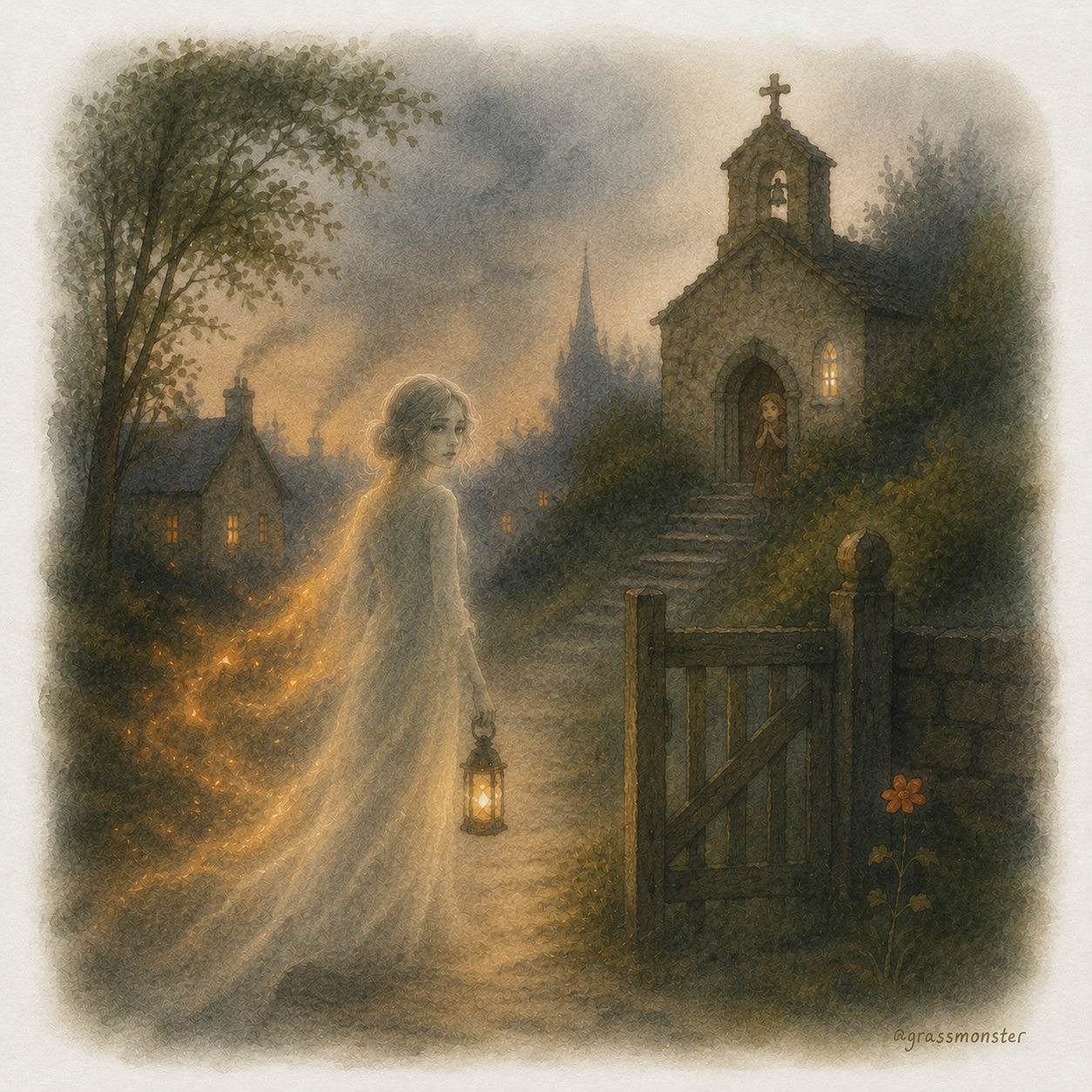 When the Flames Looked Back is a song of haunting and reckoning. It carries the image of fire not only as destruction, but as memory made visible. Flames do not merely burn in this song. They witness. They remember. They look back.
That idea gives the track its strange emotional power. Fire is usually thought of as something that consumes and moves on, leaving ash behind. But here the flames seem to hold a gaze. They become part of the story's conscience, as if the past itself has taken light and turned its face towards the living.
The song belongs to that old folk tradition where landscape, weather, and elemental things are never silent. A gate, a chapel, a lane at dusk, a lantern, a flower, and a house-light in the distance can all become witnesses. In this world, even fire has memory.
The woman on the dusk road
At the centre of the song is a solitary figure moving through evening. She is not rushing, yet there is purpose in her steps. The road feels familiar, but not easy. It carries the weight of what has happened before.
She walks with a lantern, and that lantern matters. It is a small human light held against a larger darkness. It suggests courage, grief, and the need to keep going even when memory burns too close.
The woman is not simply travelling through a place. She is returning to something. The song gives the sense that the journey is both physical and inward. Each step takes her nearer to a gate, a chapel, a memory, or a truth that has waited too long in the shadows.
Fire as witness
The title, When the Flames Looked Back, is the key to the whole piece. It turns fire into a witness. The flames are not passive. They have seen something. They know something. They carry the heat of an event that cannot be buried neatly.
In many songs, fire is used only for danger or passion. Here it is more complicated. It may stand for loss, accusation, purification, memory, or the moment when hidden truth becomes impossible to ignore.
That is why the song feels uneasy. The listener is not simply watching flames. The listener is being watched by them. The past has eyes. The light is not comforting in any simple way. It asks a question.
The chapel, the gate, and the flower
The imagery around the song is quiet but powerful. A chapel suggests prayer, memory, guilt, or forgiveness. A gate suggests threshold: the point between one life and another, between silence and confession, between returning and turning away.
The flower near the gate gives the song a tender counterweight. Against fire and darkness, there is still something small, living, and vulnerable. It may be remembrance. It may be apology. It may be a sign that love continues even where damage has been done.
These details matter because the song is not built from spectacle. It is built from signs. The listener is invited to read them slowly: the lantern, the gate, the chapel, the flower, the fading light. Together they form a world of grief and meaning without spelling everything out too heavily.
The sound of the song
When the Flames Looked Back needs a careful and atmospheric arrangement. It should feel like dusk rather than daylight, like a story being approached rather than declared. The music should allow room for silence, memory, and the unease of a past that has not fully settled.
There should be warmth in the sound, but also shadow. The flame should be felt in the arrangement as flicker, glow, and danger rather than loud drama. A restrained folk setting suits the song best, because the emotional force lies in what is suggested, not shouted.
In the Jenny Toledo folk project, the recording gives When the Flames Looked Back a consistent vocal and visual atmosphere, but the centre remains the human-authored song itself: its mystery, its sorrow, its elemental imagery, and its sense that memory sometimes returns as light.
Why this song matters
When the Flames Looked Back matters because it understands that the past does not always stay behind us. Sometimes it returns through places, objects, weather, sounds, and sudden images. A person may think they have walked away from an event, only to find that the event has kept walking beside them.
The song speaks to anyone who has carried a memory that will not become ordinary. It is about grief, but also about recognition. It is about the moment when something hidden or half-buried turns and faces us.
There is also a moral current in the song. Fire can reveal as well as destroy. It can show what the darkness concealed. In that sense, the song is not only about sorrow. It is about truth arriving with heat around it.
Connection to The Threadbare Tapes
As a track within The Threadbare Tapes, When the Flames Looked Back deepens the album's world of memory, loss, and human reckoning. The album has already moved through exile, debt, pursuit, remembrance, hidden music, invention, mining hardship, and prescient thought. This song brings the listener to the threshold of a more ghostly kind of memory.
It belongs to the album because it treats ordinary images as emotionally charged: a road, a gate, a chapel, a lantern, a flower, a flame. These are simple things, yet in the right song they become vessels of meaning.
The Threadbare Tapes is full of lives touched by forces larger than themselves. In this song, that force is memory itself. It glows, burns, accuses, guides, and refuses to disappear.
When the Flames Looked Back is therefore a song of return. It asks what happens when the past is not finished with us, and when the light we carry is not the only light looking back.