Listen to: Under the Red Robin Tree
A winter song of mercy and small lives
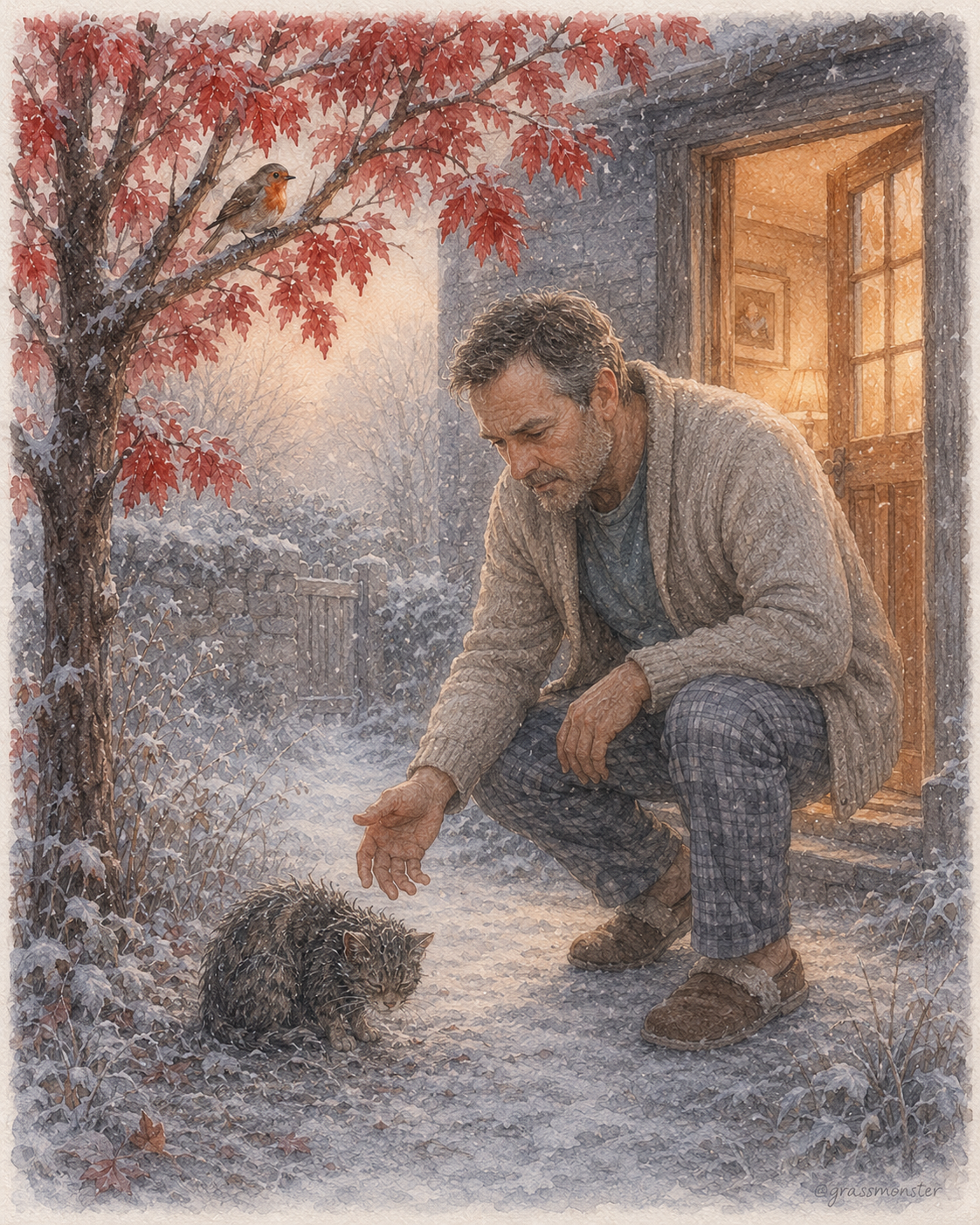 Under the Red Robin Tree is a song of tenderness, rescue, and remembrance. It begins in winter, where the world feels hard, closed, and nearly without mercy. Frost presses against the window. Wind finds its way through every small weakness in the house. The season itself seems to have forgotten how to be kind.
Then, beneath the red robin tree, kindness appears in the shape of need. A frail old cat is found in the cold, diminished by age, neglect, and suffering. She is not grand. She is not strong. She cannot announce her importance to the world. Yet the song asks the listener to see her fully.
That is the heart of Under the Red Robin Tree. It is a song about the sacred weight of small lives, and the way compassion can enter quietly, without ceremony, and change the temperature of a home forever.
The frail creature by the tree
Buttons, as she would come to be known, is first seen as a creature almost erased by the world. She is small, cold, worn by time, and marked by hardship. Her coat is dulled. Her teeth are few. Her hearing has gone. Her heart carries the uneven rhythm of age and weariness.
Yet the song does not treat her as pitiful in a shallow way. It gives her dignity. Her body may be frail, but her presence is not empty. In her silence there is a whole history of endurance. In her eyes there is still something steady, something that neglect has not managed to destroy.
This is one of the quiet strengths of the song. It asks us to look again at a creature others might pass by. It reminds us that a life does not become worthless because it is old, damaged, inconvenient, or near its end.
A hearth of compassion
Mairtin's first act is simple. He lifts her from the cold and brings her inside. That gesture is the turning point of the song. A winter morning becomes a story of mercy because one person chooses not to look away.
The sanctuary he makes for her is humble: cardboard, blankets, warmth, and a place beside the radiator. It is not grand in worldly terms, but the song understands that mercy rarely needs grandeur. It needs attention. It needs hands. It needs the willingness to make room.
In that small space by the heat, Buttons is given something the world had denied her: safety. The box beside the radiator becomes almost sacred, not because of what it is made from, but because of what it means.
From forsaken to beloved
For a week, Buttons remains in veterinary care, unclaimed and unnamed. That detail carries a quiet ache. Somewhere along the way, the world has allowed her to become a creature without a household, without an answer, and without anyone stepping forward to say she belongs.
But the song refuses to leave her there. By a quiet act of choosing, she becomes family. Not through contract in any cold sense, and not through possession, but through companionship born of compassion.
That is where the song deepens. Buttons is not rescued into usefulness. She is rescued into love. She does not need to earn her place. Her presence is enough.
The years of Buttons
The years that follow are not dramatic, and that is why they matter. Buttons curls at Mairtin's feet. She shares the warmth of the house. Her purr is small, but steady. She does not conquer the home. She blesses it by being there.
Under the Red Robin Tree understands the gentle rhythm of animal companionship. A beloved creature changes a house not by speeches, but by habit: the familiar place where they sleep, the sound of movement in another room, the small routines built around feeding, resting, watching, and keeping company.
Buttons brings with her a quiet cure for loneliness. In her small life, two solitudes meet and become something softer. She is comforted, and she comforts in return.
Her gentle passing
Three winters pass. Time does not stop for love, though love may wish it could. Buttons grows older, her heart weaker, her body more tired. Yet the song treats her final season with great tenderness.
Her passing is not described as violent or cruel. She leaves softly, almost as softly as she arrived. It is as if she slips into the folds of sleep, having finally known warmth, shelter, and belonging.
There is sorrow in this, but not only sorrow. There is also gratitude. The song knows that a life can be brief in our keeping and still become permanent in the heart.
The echo of absence
After Buttons is gone, the house changes. Absence has a sound of its own. The place beside the radiator becomes an empty monument. The rooms remember her. The quiet becomes different from the quiet before she arrived.
Those who have loved an animal understand this. The grief may look small from the outside, but inside the home it is enormous. A bowl, a blanket, a favourite place, or a sleeping corner can carry more feeling than words can manage.
Under the Red Robin Tree gives dignity to that grief. It does not apologise for mourning a cat. It understands that love is not measured by size, species, or the opinion of those who have never shared such companionship.
The red robin tree
The red robin tree becomes the song's living symbol. It is the place of discovery, but also the place of memory. Beneath it, winter once revealed a life in need. In time, it becomes part of the continuing remembrance of Buttons.
The robin itself carries a gentle folk feeling: small, bright, watchful, often associated with winter, presence, and quiet visitation. Around that image, the song gathers its tenderness. The red of the robin, the cold of the season, the frail cat beneath the tree, and the warmth of the home all belong to the same emotional world.
In this way, the tree does not simply mark a location. It becomes a threshold between abandonment and mercy, between cold and warmth, between loss and remembrance.
The sound of the song
Under the Red Robin Tree needs a gentle arrangement. It should feel intimate, domestic, and winter-lit. The song should not be overburdened with sentiment, because its feeling is already strong enough when handled with restraint.
The music should carry the softness of a quiet room, the hush of snow, the low warmth of a radiator, and the fragile dignity of an old cat finally safe. It should move slowly enough for tenderness to be felt, but not so slowly that it sinks into despair.
In the Jenny Toledo folk project, the recording gives Under the Red Robin Tree a consistent vocal and visual atmosphere, but the centre remains the human-authored song itself: its compassion, its memory, its respect for small lives, and its belief that mercy is never wasted.
Why this song matters
Under the Red Robin Tree matters because it honours a kind of love often overlooked. It is not a grand romance, a public triumph, or a heroic legend. It is the story of a frail animal found in winter and given warmth.
That may sound small, but the song knows better. Mercy shown to the vulnerable is one of the clearest measures of the human heart. A person who stops for a suffering creature has already refused the coldest logic of the world.
The song also matters because it understands that rescue does not cancel loss. Buttons is saved, loved, and given peace, but time still takes her. The comfort lies not in pretending death can be avoided, but in knowing that her final years were changed by kindness.
Connection to The Threadbare Tapes
Within The Threadbare Tapes, Under the Red Robin Tree stands as a remembrance of tenderness, loss, and unexpected mercy. The album is full of lives under pressure: the exiled, the indebted, the hunted, the grieving, the visionary, the labouring, the haunted, and the silenced. Buttons belongs among them in her own humble way.
Her story brings the album into the quiet domestic world of animal companionship. It reminds the listener that folk storytelling need not always look towards battlefields, mines, roads, or public histories. Sometimes the most powerful story is found beside a radiator, under a winter tree, in the small breathing presence of a creature finally safe.
The Threadbare Tapes is concerned with what remains after hardship. In this song, what remains is love: simple, chosen, faithful, and warm.
Under the Red Robin Tree is therefore a song of winter mercy. It remembers Buttons not as a symbol only, but as a little soul who made the cold world warmer simply by being there.